







Technician-Approved Insights
Dryer Not Heating? Safe Checks and Repair Options
Dryer Not Heating? Common Causes, Safe Checks and Repair Options A dryer not heating may have an air-only setting selected, a heating-system fault or an electrical supply problem. Clothes that…
5/5
“My LG fridge stopped cooling properly, so I called Protek Appliance Repair. They came out, found the problem pretty quickly, and got it working again. The technician was a nice guy, easy to deal with and didnt try to upsell me on anything. Everything’s been good since the repair… would definitely use them again.”

Tali Azulay

Real-Time Repair Tracking
See your repair progress, status updates, and completed stages from one convenient portal.
Inspect
100%
Repair
27%
Verify
0%
Clean Up
0%
Date:
September 6, 2026
Table of Contents
Dryer Not Heating? Common Causes, Safe Checks and Repair Options
A dryer not heating may have an air-only setting selected, a heating-system fault or an electrical supply problem. Clothes that stay damp despite some warmth can point to load size, poor spin extraction or restricted airflow. Start by identifying whether your dryer is conventional electric, gas or ventless, because the right checks depend on its design.
Stop troubleshooting if there is a safety warning:
- Gas smell: Leave immediately. Do not operate the dryer, lights, switches or a phone near the suspected leak. From a safe distance, call 911 or Enbridge Gas’s Ontario emergency line at 1-866-763-5427. Follow Enbridge’s gas-leak guidance.
- Smoke or fire: Get out, stay out and call 911 from safety. Do not delay your escape to investigate the appliance. See Toronto’s fire escape guidance.
- Burning odour without visible smoke: Stop using the dryer. Switch it off only if you can safely reach the controls and there is no suspected gas leak. Arrange an inspection before reuse.
- Repeated breaker trips: Leave the dryer off and do not keep resetting the breaker. Ontario’s Electrical Safety Authority identifies frequent trips as a reason to have a Licensed Electrical Contractor assess the electrical system.
Do not touch electrical equipment near standing water or run another test cycle when a hazard is suspected.
First, identify your dryer design
Check the owner’s manual or purchase documents. If the model label is accessible inside the door opening, record it without moving the appliance. A stacked installation or front-loading door does not identify the heating system.
Conventional vented electric dryers use resistance heating elements. Gas dryers use a burner. Both discharge moist air outdoors through an exhaust duct.
Ventless dryers collect moisture as water instead. Conventional condenser dryers use an electric heater; heat-pump dryers recycle heat through a refrigerant system. Some hybrid heat-pump models also have an auxiliary heater. Ventless dryers do not have an outside exhaust duct to inspect. Whirlpool Canada explains these design differences.
Use this table to choose the relevant troubleshooting direction. These are possibilities, not diagnoses.
| Dryer design | What you notice | Relevant possibilities | Safe starting point |
|---|---|---|---|
| Vented electric resistance | Drum turns, but a heated cycle stays cold | Cycle setting, incomplete electrical supply, heater or temperature-control fault | Check the selected cycle and record when the problem began |
| Vented gas | Drum turns with no heat, or heat is intermittent | Gas supply, ignition, gas-valve or control problem | Check the cycle; leave gas components to a qualified professional |
| Heat-pump ventless | Laundry feels cooler, or drying has become much slower | Normal lower-temperature operation, filters, load, drainage or heat-pump fault | Compare with previous performance and check manual-approved maintenance |
| Conventional condenser ventless | Clothes remain damp despite tumbling | Filter or condenser maintenance, water collection, heater or control problem | Follow the manual’s filter, condenser and tank instructions |
The component distinctions are described in Maytag’s dryer-parts guide. The guide covers conventional gas and electric designs, so its component advice should not be transferred wholesale to heat-pump machines.
Is there no heat, or are clothes simply drying poorly?
Describe what happened during the last normal use before changing anything. Did the clothes remain cold throughout, become warm but stay damp, or dry unevenly? Did the cycle finish unusually early?
A blocked vent can prevent a vented dryer from removing moisture even when it produces heat. Wet clothes alone therefore do not establish that the heater has failed. Whirlpool distinguishes heating problems from airflow-related drying problems.
A heat-pump dryer needs a different comparison. Whirlpool’s HybridCare manual explains that its laundry may feel cooler and its warm-up phase takes longer than a traditional dryer’s. Compare similar loads on the same machine rather than expecting the heat of an older vented model. A marked decline from its previous performance still deserves attention. HybridCare use and care guide, page 4.
Safe checks before arranging service
Only continue when none of the warning signs above is present. Keep checks to controls and maintenance points the manufacturer identifies for owner access.
1. Check the cycle and temperature setting
Air Only, Air Fluff and similar settings tumble without adding heat. A cool-down stage can also explain why the dryer feels cool near the end of a cycle.
Select the programme intended for the fabric and follow its care label. Do not automatically choose maximum heat. If the manual provides a heating check, use only the procedure for your model; a brief conventional-dryer test is not a universal heat-pump test. Whirlpool’s electric-dryer support guidance.
2. Check the load and the washer’s final spin
Laundry needs room to tumble. Separate heavy towels from lightweight items and loosen bedding that has rolled into a tight bundle, with the dryer stopped.
Clothes entering the dryer should not be dripping wet. If the washer did not complete its final spin, follow its manual for a suitable spin cycle, provided the fabrics allow it. Do not select a higher spin speed than the garment can tolerate. Miele Canada’s drying-performance guidance.
When clothes repeatedly leave the washer unusually wet, the problem may begin before drying. ProTek’s washer repair page covers poor spinning and clothes coming out too wet.
3. Clean the accessible lint filter
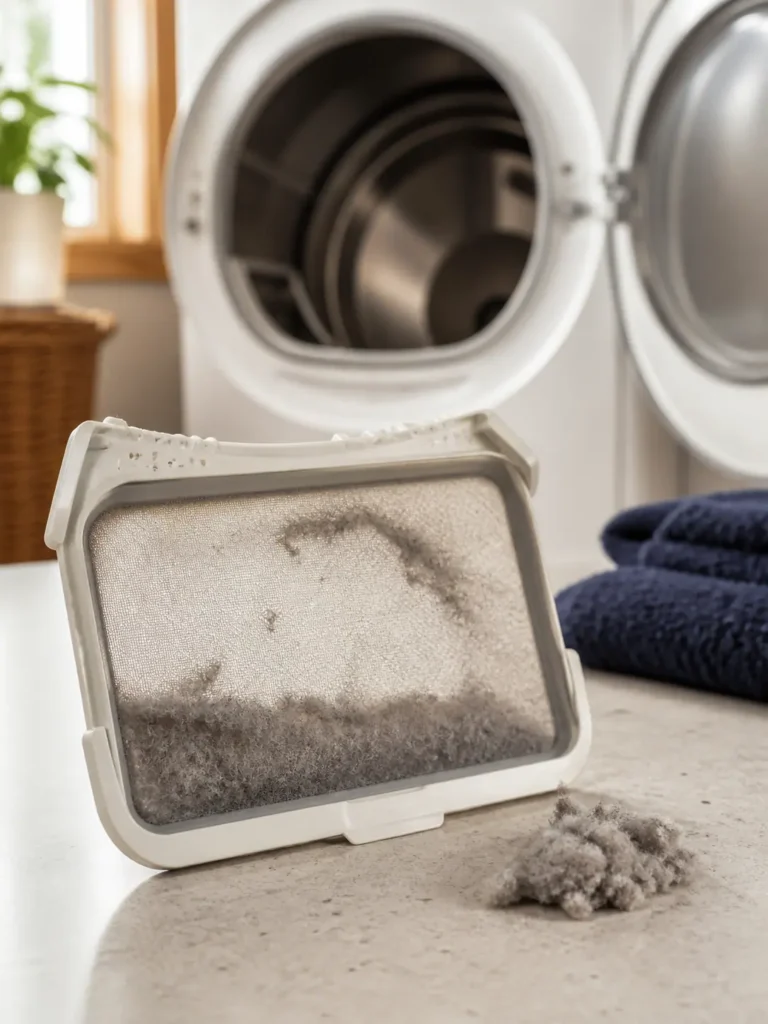
With the dryer stopped and cool, remove lint from the filter using the method in the manual. If washing is permitted, follow the manufacturer’s cleaning and drying instructions before reinstalling it.
Do not run the dryer with a missing, damaged or poorly seated filter. Cleaning the screen also does not establish that the rest of the airflow path is clear. Toronto recommends lint-screen cleaning after each load and regular attention to exhaust restrictions on vented dryers. Toronto dryer fire-safety guidance.
4. Follow the maintenance route for your design
For vented dryers: Look only at duct sections already visible without moving the machine. Note obvious crushing or damage. If the outside termination is safely visible from ground level, look for an obstruction. Leave inaccessible ducts and repairs to a professional. Do not disconnect the exhaust and run the dryer indoors.
For ventless dryers: Check the manual for additional owner-serviceable filters, a condenser or heat-exchanger cleaning procedure, and a water-container reminder. Empty a collection tank only as directed; a directly drained model may not use it in the same way.
Do not assume a lower access flap means every component behind it is washable or removable. Miele warns that heat-exchanger fins can be sharp and that incorrect cleaning can damage them. Follow the exact model instructions, including whether filters must be dry before refitting. Miele Canada’s filter and heat-exchanger guidance.
If the problem remains after the applicable checks, record the symptoms and arrange diagnosis instead of repeatedly extending the cycle.
What a professional may need to diagnose
Electrical supply, heaters and controls
A turning drum does not always prove the full heating supply is present. On applicable conventional electric dryers, the motor may operate while the required heating supply is incomplete. A qualified professional must assess the supply against the model’s requirements. Do not test the outlet, tighten wiring or open the terminal cover yourself. Whirlpool’s electrical-supply explanation.
Inside the appliance, possible faults include the resistance heater, a thermostat that regulates temperature, a temperature sensor, wiring or the control that requests heat. Testing is needed to distinguish these possibilities.
Gas ignition and heat-pump operation
For a gas dryer, an igniter starts combustion, while associated sensors and valves help control burner operation. A fault can prevent heat or make it intermittent. These symptoms do not identify a particular failed part. Maytag’s gas-component descriptions.
Arrange gas work through a TSSA-registered contractor using an appropriately certified technician. Do not disconnect the gas line or attempt burner repairs. TSSA contractor and certification requirements.
For a heat-pump machine, diagnosis must account for its refrigeration system, airflow, sensors and controls. A conventional heating-element replacement is not a universal solution. Refrigerant-system work belongs with a suitably qualified professional.
Thermal protection and the underlying cause
A thermal fuse or cut-off is a protective device, not simply a part to bypass when heat disappears. Depending on the circuit, an activated device may interrupt heating or stop operation.
Replacing a failed protective component without investigating why it opened can leave the problem unresolved. For example, Whirlpool’s technical documentation requires checks for exhaust restrictions and, on applicable electric models, heater malfunction alongside a thermal cut-off repair. This is professional diagnostic work, not a homeowner procedure. Whirlpool technical sheet, page 19.
Frequently asked questions
Why does my dryer finish early while clothes are still damp?
An automatic cycle depends on moisture sensing. Load contact, the selected dryness level or residue on accessible sensor bars can affect the result. Follow the manual before cleaning sensors; an early finish does not by itself prove they need replacement. Frigidaire’s drying-performance guidance.
Does an error code tell me which part to buy?
Usually it identifies a condition or system needing investigation. Record the exact code and model number. The same-looking code can have different meanings across products, and wiring or control issues can resemble sensor faults. Use the matching manual rather than a generic code list.
How long should a dryer take to dry clothes?
There is no single acceptable time for every design, programme and load. Fabric weight, spin extraction and load size affect drying. Compare the result with the manual and your machine’s previous performance on similar loads. Frigidaire’s extended-drying guidance.
Who should handle a suspected condo vent problem?
Ask building management who is responsible for the duct serving your unit and how inspection access is arranged. Report visible restrictions and previous maintenance information. Do not pull out a stacked dryer or enter a ceiling space. A ventless dryer needs a different investigation.
Is a dryer that does not heat worth repairing?
Base the decision on the confirmed fault, written estimate, overall condition, repair history and parts availability. Compare that with the full replacement and installation cost, including any stacking or access requirements. Check existing warranty coverage before authorizing work; age alone does not settle the decision.
Arrange a dryer assessment
If the safe checks have not resolved the problem, contact ProTek about dryer repair. Provide the model number, dryer design, selected cycle, any error code and whether the clothes stayed cold or became warm but remained damp. For a Toronto or GTA condo visit, include building access requirements and whether the appliance is stacked. Confirm support for your specific heat-pump or ventless model when booking.
Get your appliances serviced
within the next 24 hours!
🔒 By submitting, you agree to our Privacy Policy and consent to communication regarding your request. We never sell your data.
Get your appliances serviced within the next 24 hours!
🔒 By submitting, you agree to our Privacy Policy and consent to communication regarding your request. We never sell your data.