









Technician-Approved Insights
Dishwasher Not Draining? Common Causes, Safe Checks and Repair Options
Dishwasher not draining? Learn what standing water means, safe filter and hose checks, installation issues, and when to call an appliance tech or plumber.
5/5
“My LG fridge stopped cooling properly, so I called Protek Appliance Repair. They came out, found the problem pretty quickly, and got it working again. The technician was a nice guy, easy to deal with and didnt try to upsell me on anything. Everything’s been good since the repair… would definitely use them again.”

Tali Azulay


Real-Time Repair Tracking
See your repair progress, status updates, and completed stages from one convenient portal.
Inspect
100%
Repair
27%
Verify
0%
Clean Up
0%
Date:
September 3, 2026
Table of Contents
Dishwasher Not Draining? Common Causes, Safe Checks and Repair Options
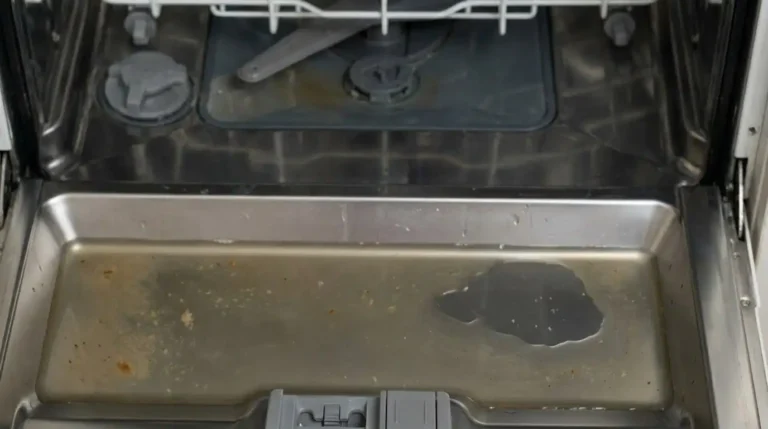
A small amount of water in the filter well or sump can be normal on some dishwashers. Water covering the filter, pooling across the tub floor, returning after the sink drains, or remaining after repeated completed cycles usually needs attention. Common causes include a dirty filter, restricted drain hose or sink connection, incorrect installation or backflow, and a pump or control fault. The symptom alone does not identify the failed part.
Stop first if water is near an electrical connection, the dishwasher is leaking onto the floor or cabinetry, you smell burning, see smoke or damaged wiring, or the breaker trips again. Keep away from wet electrical equipment. If there is fire or immediate danger, leave the area and call 911 in Ontario. If you smell rotten-egg gas, leave immediately and call Enbridge Gas Ontario or 911 from a safe location.
Is a little water in the dishwasher normal?
Sometimes. Frigidaire Canada says some water can remain in the bottom after a completed wash cycle. It recommends checking the drainage system if water covers the filter screen.
Maytag Canada also notes that a small amount of standing water is not uncommon. Its guidance uses about 1 inch, or 2.5 centimetres, as a possible warning sign, but that is not a universal measurement for every dishwasher.
Look at where the water sits:
- A small amount confined to the recessed filter or sump area may be normal.
- Water covering the filter, spreading across the tub floor, or sitting near the door opening is more concerning.
- Dirty or foul-smelling water returning after the sink drains suggests a connection, plumbing, backflow, or check-valve problem.
- A sink that also drains slowly points more strongly toward a plumbing restriction.
Your owner’s manual should take priority because filter design, sump shape, drain routing, and normal water levels vary by model.
Dishwasher drainage symptoms and next steps
| Symptom | Possible cause | Safe action | Professional escalation |
|---|---|---|---|
| Small amount of clear water only in the filter well | Normal residual water on some models | Check the model manual and monitor the next completed cycle | No immediate call unless the amount increases or the water becomes dirty |
| Water covers the filter or pools across the tub floor | Filter, sump, hose, valve, or pump restriction | Clean the accessible filter exactly as the manual describes and inspect the visible hose | Appliance technician if water remains |
| Dirty water returns after the sink drains | Backflow, blocked sink connection, high-loop or air-gap issue, or check valve not sealing | Stop running cycles and inspect only visible connections | Plumber or building management, with appliance service if the appliance-side drain system is involved |
| The sink is also slow, gurgling, or backing up | Shared drain, trap, or downstream plumbing restriction | Do not pour chemical drain cleaner into the dishwasher | Plumber or condo building management |
| Problem began after installation or under-sink work | Kinked hose, incorrect routing, missing disposer knockout plug, or poor backflow protection | Photograph the visible routing and do not pull the appliance out | Installer, plumber, or building management |
| Humming, grinding, recurring drain code, or no pump sound | Pump obstruction, pump fault, wiring, valve, or control problem | Stop the appliance and do not reach into the pump or test live circuits | Appliance technician |
| Active leak near flooring, cabinetry, or wiring | Leak, loose connection, seal failure, or overfill condition | Stop using the dishwasher and close the accessible water valve only if safe | Appliance technician; notify building management in a condo |
Common reasons a dishwasher will not drain
A dirty filter or restricted sump
Food particles, paper labels, bones, pits, and broken glass can collect in the filter or sump area. A restricted filter can look similar to a pump failure because water remains in the tub even though the dishwasher has power.
Do not assume that a visible obstruction proves the pump is defective. The filter, drain path, pump, valve, wiring, and control system can produce similar symptoms.
A kinked or blocked drain hose
Inspect the portion of the drain hose that is visible under the sink or inside an accessible cabinet. Look for a sharp bend, crush point, sag, or recent movement after plumbing or cabinet work.
Do not pull a built-in dishwasher forward to inspect the rear hose. A built-in unit can be heavy, difficult to support, and connected to water and electrical lines.
A sink or plumbing restriction
Dishwashers commonly drain into the kitchen sink plumbing, but kitchens are not all configured the same way. Some have a countertop air gap. Some connect to a disposer. Others use a sink tailpiece or another plumbing arrangement.
If the sink drains slowly, gurgles, or backs up, the dishwasher may only be showing the effect of a plumbing problem. If dirty water appears after the sink is used, the problem may involve the shared connection, drain trap, air gap, hose routing, or a non-return valve.
Incorrect installation or backflow
A drain hose normally needs suitable routing to prevent siphoning and wastewater from flowing back into the dishwasher. Whirlpool explains that a high loop or working air gap helps prevent wastewater from returning to the tub.
Exact installation requirements vary. For example, Whirlpool guidance uses a 20-inch minimum in some installations, while Frigidaire Canada specifies different hose-height guidance. Do not treat either measurement as universal. Use the installation instructions for the exact model.
A new disposer can also cause a complete drainage failure if its dishwasher inlet knockout plug was not removed. That issue only applies where a disposer is installed.
Safe checks before calling for service
- Identify the model and record the symptom. Note the brand, complete model number, error code, and where the cycle stopped. A cancel or drain command is not universal. Use the exact owner’s manual instead of guessing at a button sequence.
- Let hot water cool. Do not handle water immediately after a hot cycle. If there is water on the floor or near an electrical connection, stop and arrange service rather than reaching around the appliance.
- Clean the accessible filter. Remove the lower rack only if it lifts out normally. Locate the filter and follow the manual’s removal instructions. Rinse it under running water and use a soft brush for residue. Maytag recommends avoiding wire brushes and abrasive pads because they can damage the filter.Reinstall the filter flat and locked according to the manual. Do not reach blindly into the pump opening. Broken glass, bones, and other sharp debris may be difficult to see. Do not remove a pump cover unless the exact consumer manual expressly permits it and provides the required shutdown and safety steps.
- Inspect only the visible hose and sink connection. Look under the sink for an obvious kink, crush point, sag, loose connection, or air gap blockage. Follow the air-gap manufacturer’s instructions if one is installed. Do not assume that every kitchen has an air gap or disposer.
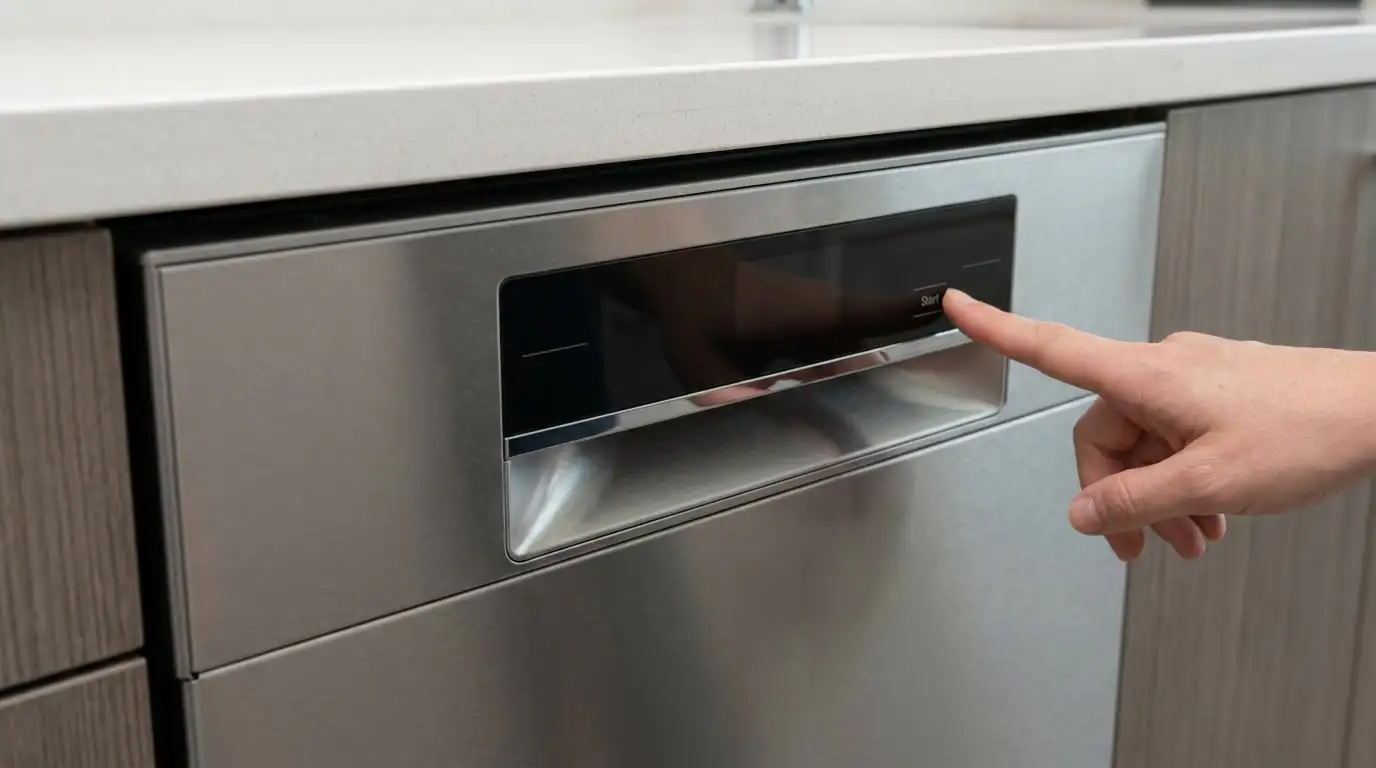
- Test only as the manual permits. If the manual provides a model-specific drain or cancel procedure, use it once after the filter is correctly reinstalled. Stop if the water returns, a leak appears, the pump only hums, grinding continues, or the code returns.
Do not pour chemical drain opener into the dishwasher. Whirlpool warns that drain-opening chemicals can damage components and create safety hazards. Do not remove electrical panels, test live voltage, bypass leak protection, repeatedly reset a tripping breaker, tilt the machine, or disconnect hoses unless the exact manual and a safe working setup clearly permit it.
Bosch E24 and E25, and Miele F11
Error codes narrow the area of concern, but they rarely prove which part has failed.
- Bosch E24: Bosch Canada associates this code with improper draining and possible filter, hose, pump-cover, or disposer-connection problems.
- Bosch E25: Bosch associates this code with a blocked drain pump or a loose or missing pump cover.
- Miele F11: Miele Canada describes F11 as a drainage fault for specific G7xxx and G5xxx Discovery models manufactured from 2019 onward. The listed possibilities include pump-cover positioning and a blocked pump.
Use the support page and manual for the exact model. A code that returns after a safe filter check needs proper diagnosis rather than repeated resetting.
Should you call an appliance technician, plumber, or building management?
Call an appliance technician when the dishwasher is the only fixture affected, the sink drains normally, the accessible filter and hose are clear, or the appliance hums, grinds, displays a recurring code, or fails to start the drain pump.
Call a plumber or condo building management when the sink or other fixtures are also slow, wastewater returns when the sink drains, the air gap or sink connection overflows, or the issue appears to involve a shared or common drain.
If the problem started after a new dishwasher installation, disposer replacement, cabinet work, or under-sink plumbing change, contact the installer or building management before moving the appliance or changing the connection.
For a dishwasher-only drainage problem that remains after the model-specific safe checks, you can book dishwasher repair with ProTek Appliance Repair. Have the make, model, full code, cycle timing, sink behaviour, recent installation details, and any leak information ready. General booking questions can be reviewed through ProTek’s appliance repair FAQ.
Frequently asked questions
Why is my dishwasher not draining after a cycle?
The filter, sump, drain hose, sink connection, air gap, check valve, pump, or control system may be involved. Start with the exact manual’s filter procedure and an inspection of any visible hose section. If the water remains, arrange professional diagnosis.
Is water in the bottom of a dishwasher always a problem?
No. A small amount in the recessed filter or sump area can be normal on some models. Water covering the filter or spreading across the tub floor is more concerning, especially if it is dirty, recurring, or returning from the sink.
Can a sink blockage stop a dishwasher from draining?
Yes. A dishwasher may share the sink drain, trap, tailpiece, air gap, or disposer connection. If the sink is also slow or backs up, contact a plumber or condo building management.
Does Bosch E24 or E25 always mean the drain pump is bad?
No. Bosch Canada lists filter, hose, pump-cover, disposer-connection, and pump causes. The code identifies a drainage problem, not a confirmed failed component.
Should I pour drain cleaner into a dishwasher?
No. Chemical drain opener can damage dishwasher components and create a safety hazard. Use only the safe maintenance steps supported by the owner’s manual, then call a professional if the restriction remains.
Get your appliances serviced
within the next 24 hours!
🔒 By submitting, you agree to our Privacy Policy and consent to communication regarding your request. We never sell your data.
Get your appliances serviced within the next 24 hours!
🔒 By submitting, you agree to our Privacy Policy and consent to communication regarding your request. We never sell your data.