









Technician-Approved Insights
Fridge Not Cooling? Safe Checks and When to Call ProTek
Fridge not cooling? Compare fridge and freezer symptoms, check temperatures, protect your food and learn when to arrange refrigerator repair in Toronto.
5/5
“My LG fridge stopped cooling properly, so I called Protek Appliance Repair. They came out, found the problem pretty quickly, and got it working again. The technician was a nice guy, easy to deal with and didnt try to upsell me on anything. Everything’s been good since the repair… would definitely use them again.”

Tali Azulay


Real-Time Repair Tracking
See your repair progress, status updates, and completed stages from one convenient portal.
Inspect
100%
Repair
27%
Verify
0%
Clean Up
0%
Date:
September 4, 2026
Table of Contents
Fridge Not Cooling? What to Check and When to Call a Technician
If your fridge is not cooling, protect perishable food first, then check measured temperatures, control settings, door closure and blocked internal vents. Compare the freezer with the fridge: one warm compartment suggests a different troubleshooting path from two warm compartments, but neither pattern identifies a failed part. Arrange service if safe checks do not restore reliable cooling.
If there is smoke or fire, stop troubleshooting, leave the home and call 911 from outside. Follow your building’s fire plan in a condo. Toronto Fire Services’ home fire safety guidance explains planning an escape and calling for help.
Protect the food before troubleshooting
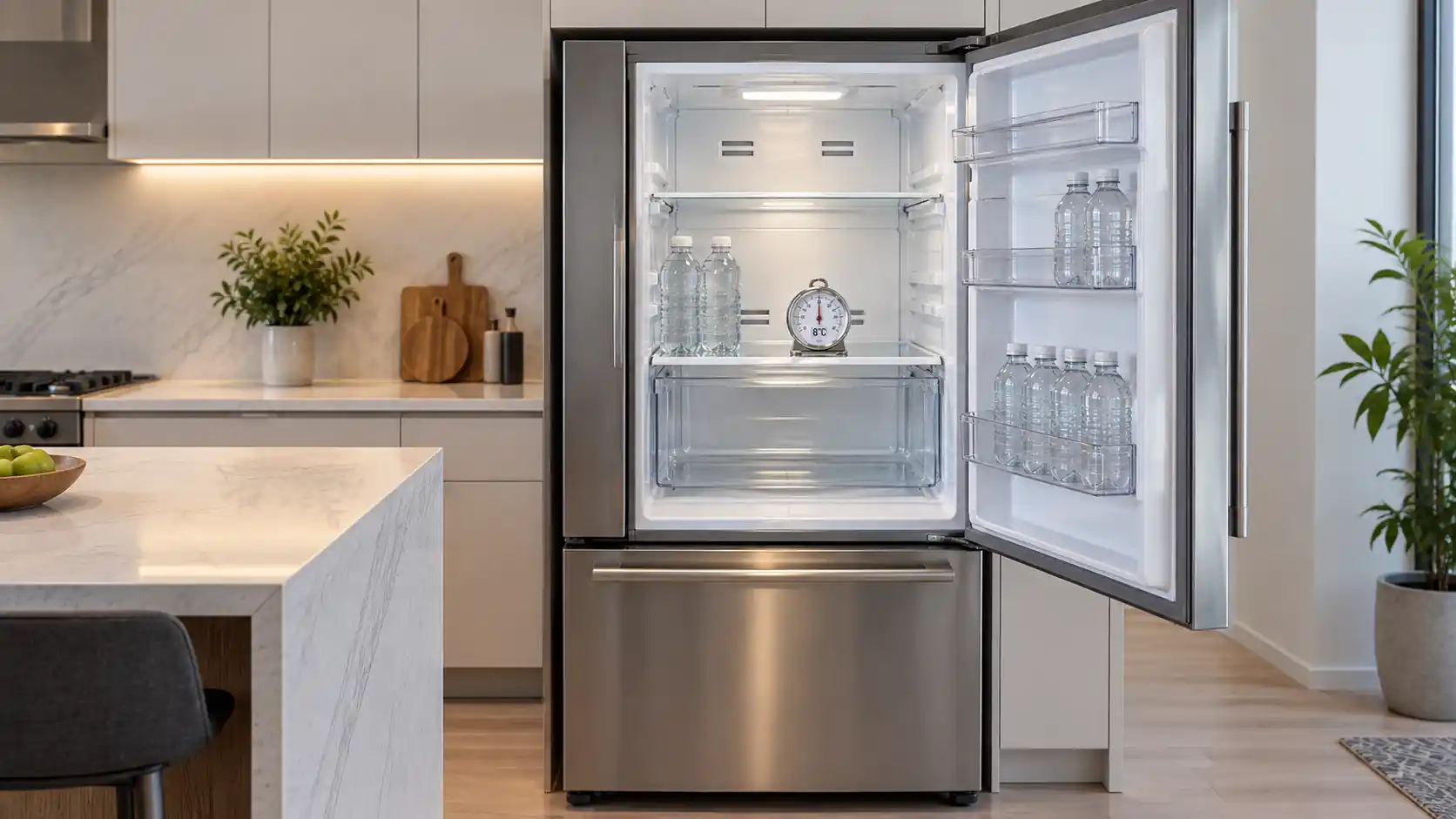
Your refrigerator should hold food at 4°C or colder, and your freezer should be −18°C or colder. Use appliance thermometers to check both compartments. A temperature setting on the door is not enough to establish safe storage. Health Canada’s emergency food-safety guidance specifies these temperatures and recommends thermometers.
Move perishable food to a working refrigerator or a cooler supplied with enough ice to keep it at 4°C or colder. Keep raw meat contained so its juices cannot contaminate other food.
Perishable foods such as meat, poultry, fish, dairy and eggs should be discarded if they have been above 4°C for more than two hours. This temperature-and-time limit appears in Simcoe Muskoka District Health Unit’s food-safety advice.
A power outage and a malfunctioning fridge need different timing decisions. Health Canada says an unopened refrigerator generally keeps food cold for about four hours during an outage. That estimate is not four extra hours after you discover a mechanical cooling problem. The fridge may already have been warming overnight.
If you cannot establish how long perishables have been warm, take the conservative approach and discard anything whose safety is uncertain. Smelling or tasting food cannot establish that it is safe. Health Canada’s safe food storage guidance makes that distinction clear.
Start with the freezer’s condition
Check actual temperatures where possible. “The freezer feels cold” is a useful observation, but it is less informative than a thermometer reading.
| Symptom | Safe observation | Next action |
|---|---|---|
| Fridge warm, freezer maintaining its temperature | Record both readings; look for packages covering vents | Clear visible obstructions and check doors and settings; arrange service if warming persists |
| Both compartments warm | Note lights, display messages and any recent outage | Protect food, check accessible controls and request diagnosis if cooling remains absent |
| Warming comes and goes | Record times, readings, door use and recent loading | Share the pattern with a technician if it recurs |
| New installation or recent power interruption | Note when power started or returned | Follow the model’s start-up instructions while keeping perishables safely elsewhere |
Fridge warm, freezer cold
On refrigerators that cool the fresh-food compartment using air from the freezer, blocked vents can interrupt that airflow. Whirlpool describes this arrangement in its Canadian refrigerator troubleshooting guide.
If visible vents are clear, a technician may need to investigate the fan that circulates cold air, an air-control flap where fitted, or frost interfering with circulation.
However, refrigerators do not all share the same design. Some have separate cooling sections. For example, Samsung’s Canadian RF23DB9900QDAC product information describes three evaporators, the components that absorb heat inside the appliance.
The practical implication is that a cold freezer helps narrow the investigation, but it does not prove the refrigerator’s cooling section is healthy or rule out every refrigerant-system fault. The model number matters.
Both fridge and freezer warm
This pattern calls for checking anything affecting cooling more broadly, starting with power availability, cooling settings and recent installation or interruption.
A working light does not prove that the cooling system is operating. Likewise, hearing a motor or fan does not establish that the appliance is removing enough heat.
Internal possibilities include fan, compressor or starting-component faults, but symptoms alone do not justify ordering a compressor. Whirlpool identifies these as issues requiring professional assessment when basic checks fail.
Intermittent warming
Record whether warming follows frequent door opening, a large grocery load or a door left ajar. These events can affect temperature. A door that does not seal properly can also cause unstable temperatures, as explained in Electrolux’s refrigerator cooling guidance.
Recurring warming without a clear explanation needs investigation, even if the fridge is cold again when you check it. A short record of readings and events gives the technician something more useful than “it sometimes feels warm.”
Measure temperature instead of relying on the display
A setpoint is the temperature you ask the refrigerator to maintain. A measured temperature tells you what a thermometer detects at its location.
Display behaviour varies. Whirlpool’s French-door bottom-freezer quick-start guide W11656138A, for example, describes displaying the selected compartment’s setpoint. Do not assume every display is a live temperature reading.
Use thermometers intended for refrigerator and freezer temperatures. Follow their placement and settling instructions, keep door openings brief and note when you take each reading. Do not delay moving food while waiting for a thermometer to settle.
A single air-temperature reading also cannot reconstruct the food’s temperature history. Record what you know: when the fridge last appeared normal, when warming was discovered and whether there was a known outage.
Five safe homeowner checks
Complete these after addressing food safety.
- Record the controls and signs of power. Photograph the display, including any error message, before changing anything. Note whether interior lights work. Do not pull out a heavy or built-in refrigerator to reach its plug, handle electrical equipment near standing water or repeatedly reset a tripping breaker.
- Check the model’s cooling settings. Confirm that cooling is enabled and that the selected temperatures match the owner’s manual. Some models have showroom or cooling-off modes. The Whirlpool guide above documents a “DEMO” indication for the refrigerators it covers. Use your own model’s instructions rather than trying button combinations from another refrigerator.
- Make sure both doors close fully. Move packages that prevent closure and check that drawers and shelves are seated correctly. Look for visible gasket damage or debris. Electrolux permits cleaning its door gaskets with warm soapy water; follow the cleaning instructions for your appliance.
- Unblock visible internal vents. Reposition food covering openings in either compartment. Leave room for air to circulate rather than packing containers tightly against every surface. Keep any temperature-sensor opening identified in your manual unobstructed. Do not insert tools or fingers into vents.
- Review accessible maintenance instructions. Condenser cleaning is not a universal homeowner task. Whirlpool Canada states that some models need no cleaning and others require a technician. Only perform maintenance your manual permits, with its required power precautions. For this check, leave any work involving appliance movement or cover removal to a professional. Whirlpool Canada’s condenser guidance, in French, explains these model differences.
For built-in refrigerators, report blocked exterior ventilation or suspected installation-clearance problems to the installer or technician. Do not loosen cabinetry or move the appliance yourself.
New installation or recent power interruption
A newly installed refrigerator needs time to cool, but the relevant instructions are model-specific. Electrolux’s support guidance allows 24 hours for initial temperature stabilization. This is an appliance start-up allowance, not permission to store perishables at unsafe temperatures.
Whirlpool’s W11656138A guide similarly warns against loading food before the refrigerator has cooled. It also explains that selecting a colder-than-recommended setting will not make the compartments cool faster.
After a power interruption, note when power returned and check the display against the manual. Keep food protected while checking recovery. If cooling appears absent, an error persists or temperatures continue rising, contact the manufacturer or a repair provider rather than applying a universal “wait another day” rule.
Do not repeatedly unplug and restart the refrigerator as a substitute for diagnosis.
What needs professional diagnosis?
Once accessible checks are complete, a technician may need to investigate several systems:
- Air circulation: Whether fans and any air-control mechanisms operate as required for the model.
- Defrost: Whether a frost-free model’s system is clearing frost from its cooling surfaces.
- Temperature sensing and controls: Whether the appliance senses conditions correctly and responds appropriately.
- The sealed system: Whether the refrigerant circuit and compressor are providing the required cooling.
These are investigation areas, not diagnoses established by a warm shelf, a noise or an error code.
GE’s explanation of defrost systems distinguishes automatic-defrost refrigerators from manual-defrost designs. Its GPE12FGKWW owner’s manual also explains how obstructing a temperature sensor can affect cooling.
If frost is visible, photograph it without removing anything. Do not chip ice away, use a hair dryer or remove an interior panel to expose the cooling components. Ask for model-specific advice before attempting a defrost.
Arrange service promptly if the refrigerator cannot maintain safe storage temperatures, warming keeps returning, the door will not seal or a cooling-related error persists.
Have this information ready for service
Prepare a clear photograph of the model and serial label if it is accessible without moving the refrigerator. Add both compartment temperatures, measurement times, display messages and the approximate time the problem began.
Describe observations plainly: “fridge warm, freezer measured −18°C” is more useful than “compressor broken.” Mention recent installation, outages, unusual sounds, visible frost, previous repairs and any electrical concern.
For a Toronto condo visit, explain concierge access, parking, elevator arrangements and building requirements. Clear loose belongings from the approach to the appliance. ProTek’s service terms and conditions ask customers to provide safe access and disclose known appliance issues and hazards.
Frequently asked questions
Does constant running mean the compressor has failed?
No. Some high-efficiency refrigerators run for extended periods during normal operation. Constant running combined with inadequate cooling warrants investigation, but runtime alone does not identify a failed compressor. See Whirlpool Canada’s explanation of extended motor operation.
Does a silent freezer mean its fan is broken?
No. Silence at one moment is inconclusive. GE explains that fans and the compressor can stop during automatic defrost on the models it describes. Do not bypass a door switch to force a fan test.
Should I turn the temperature to its coldest setting?
Follow your model’s adjustment instructions. Repeated changes make the recovery pattern harder to track. On models covered by Whirlpool’s W11656138A guide, a colder-than-recommended setting does not accelerate initial cooling.
Can food become safe again once the fridge cools down?
A restored temperature does not establish that previously warmed food is safe. Make the decision using its earlier temperature and time history, including the discard guidance above. Do not use smell or taste as a safety test.
Is a refrigerator that stops cooling worth repairing?
That depends on the confirmed fault, overall condition, parts availability, repair quotation and any applicable coverage. For a built-in appliance, replacement fit and installation work also deserve consideration. Ask what the diagnosis establishes before deciding.
Arrange refrigerator repair in Toronto and surrounding areas
If your fridge remains warm after the safe checks, or the problem keeps returning, request refrigerator and freezer repair from ProTek. Share the model number, both temperature readings and the timing of the problem so the service team can assess the request. Keep perishable food safely stored elsewhere while you arrange the visit.
Get your appliances serviced
within the next 24 hours!
🔒 By submitting, you agree to our Privacy Policy and consent to communication regarding your request. We never sell your data.
Get your appliances serviced within the next 24 hours!
🔒 By submitting, you agree to our Privacy Policy and consent to communication regarding your request. We never sell your data.